
Introduction to AEO and the Trusted Trader Concept
Learning objectives
- Understand the origins and purpose of the Authorised Economic Operator programme.
- Explain the relationship between AEO and the WCO SAFE Framework.
- Describe the post-Brexit position of UK AEO and its relationship to EU AEO.
- Identify the three types of AEO status available to UK operators.
1.1 What is an Authorised Economic Operator?
An Authorised Economic Operator (AEO) is a business officially recognised by a national customs authority as meeting stringent standards of compliance, security, and operational reliability within the international supply chain. It lets customs authorities distinguish reliably compliant traders from higher-risk ones; focusing inspection resources where they're needed, while trusted operators benefit from expedited processing and simplified procedures.
AEO status is not a regulatory requirement. But in an increasingly compliance-focused trading environment, it has become a powerful competitive differentiator; for SMEs especially, it provides credibility, access to simplifications, and resilience against customs-driven supply chain disruption.
1.2 Origins: the WCO SAFE Framework
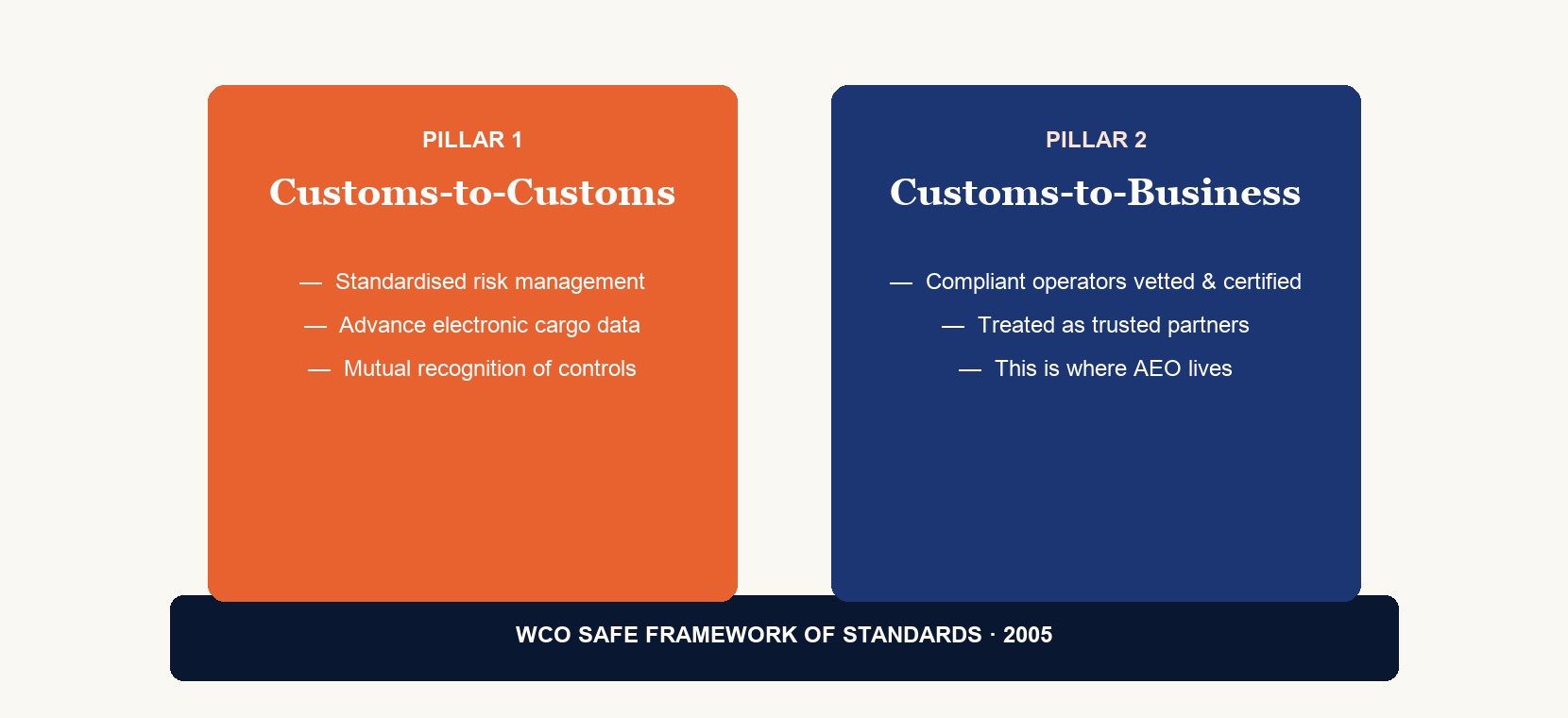
The AEO concept came from the World Customs Organisation (WCO) SAFE Framework of Standards, first adopted in 2005. SAFE introduced two pillars:
- Pillar 1; Customs-to-Customs cooperation: standardised risk management, advance electronic cargo information, and mutual recognition of controls.
- Pillar 2 (Customs-to-Business cooperation): the AEO concept itself; compliant operators are vetted, certified, and treated as trusted partners.
The EU adopted AEO as part of the modernised Customs Code in 2008, later updated through the Union Customs Code (Regulation (EU) No 952/2013), fully operational from 2016. The UK's own programme pre-dates Brexit and has been run by HMRC since 2008, continuing post-Brexit under the Taxation (Cross-border Trade) Act 2018.
1.3 AEO in the post-Brexit landscape
Until 31 December 2020, UK operators holding EU AEO certificates automatically benefited from Mutual Recognition within EU member states. That automatic recognition ended with the transition period.
- UK AEO status is issued by HMRC and governed by UK domestic law.
- EU AEO status is issued by EU member state authorities under the Union Customs Code.
- No formal UK–EU Mutual Recognition Agreement for AEO exists yet; negotiations are ongoing.
- UK AEO holders may still benefit informally from certification when demonstrating compliance credibility to EU partners.
- UK AEO is mutually recognised by a growing number of non-EU countries (Module 9).
1.4 The three types of AEO status
| Certificate | Full name | Summary |
|---|---|---|
| AEO(C) | Customs Simplifications | Customs compliance and simplifications. Relevant to importers, exporters, customs agents. Grants simplified declarations and deferred payment. |
| AEO(S) | Security and Safety | Supply chain security standards. Relevant to all supply chain actors. Grants reduced physical/documentary checks at entry/exit. |
| AEO(F) | Full / Combined | AEO(C) + AEO(S) together. The full range of simplifications and facilitations; most comprehensive, highest compliance burden. |
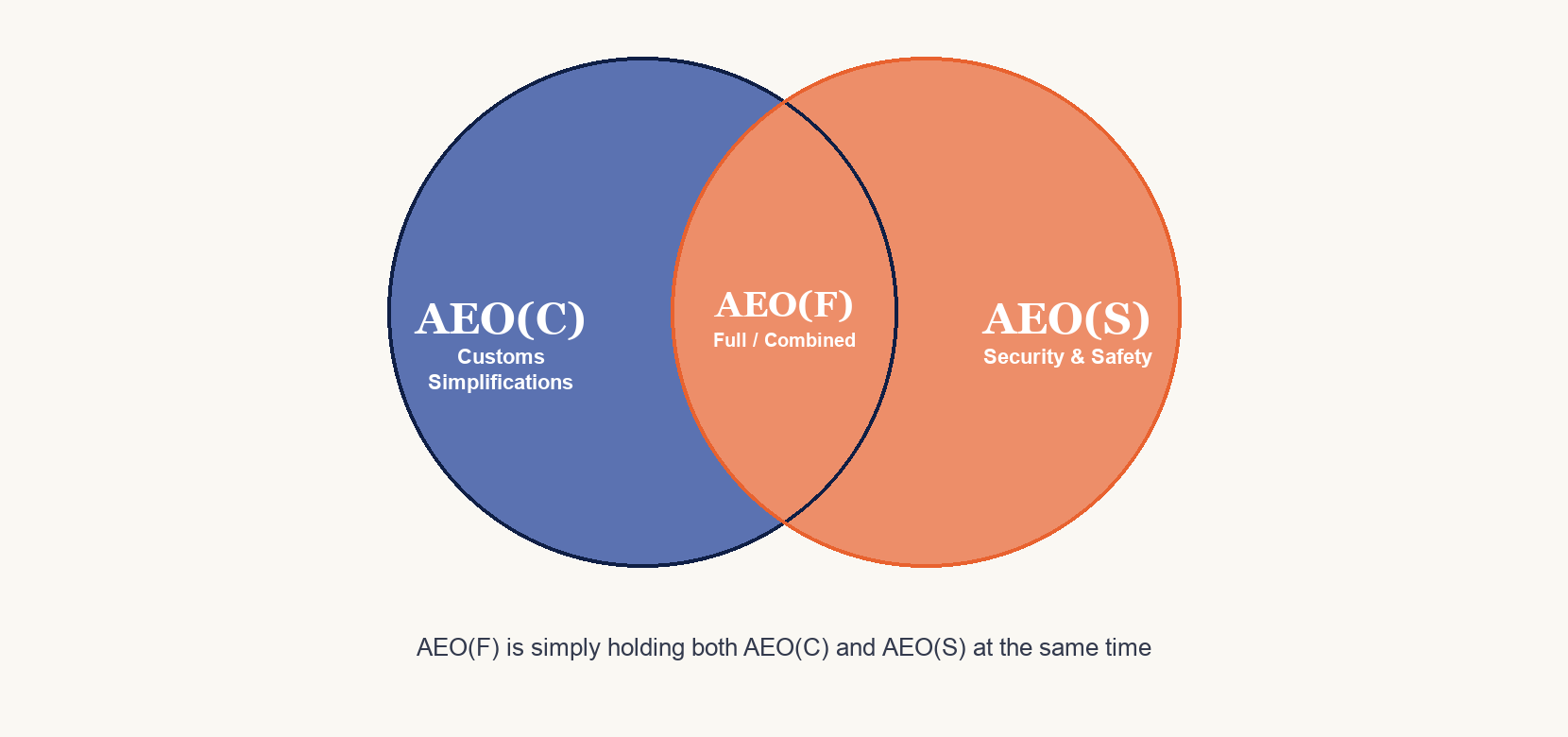
This programme covers AEO(C) and AEO(S) in detail throughout, and where the combined AEO(F) status is relevant, it is called out explicitly.
Enrol to unlock the rest of UK AEO Certified Practitioner Programme, including quizzes and your certificate.
Enrol now